What Goes Into An Income Statement
What Goes Into An Income Statement. Income statement or otherwise called as statement of profit and loss, is the summary prepared by the company’s management, reporting the revenues,. This section includes total sales, the cost of.
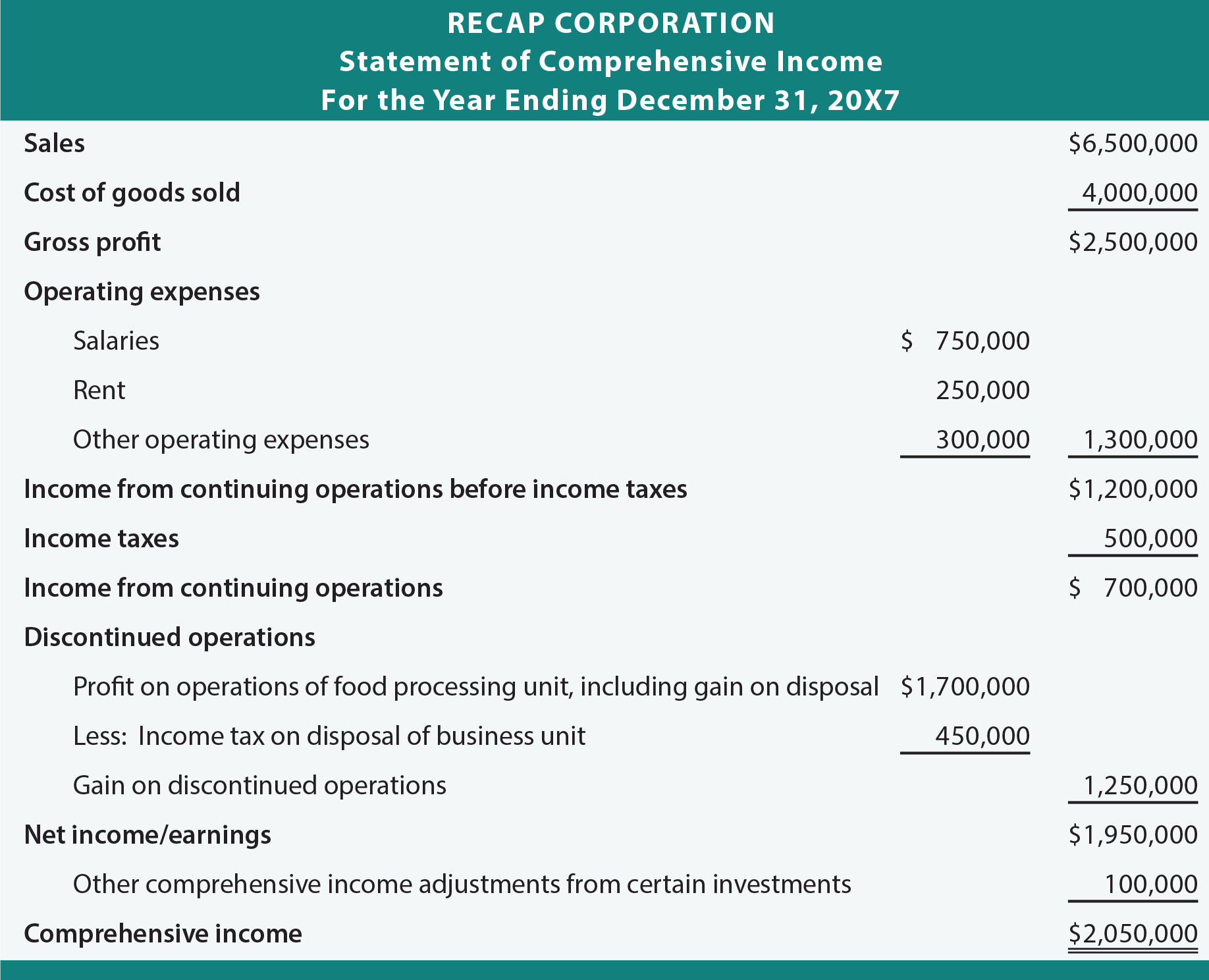
Income is a monetary value that can provide savings and consumption opportunities for an individual. It's a challenge to conceptualize. This is why the definition of income could differ depending on the specific field of study. The article below we will examine some of the most important components of income. We will also discuss interest payments and rents.
Gross income
The gross income refers to the sum of your earnings before taxes. In contrast, net income is the total amount of your earnings, minus taxes. It is essential to comprehend the distinction between gross and net income to ensure that you can accurately record your earnings. Gross income is a better measurement of your earnings since it gives a clear image of how much you make.
Gross profit is the money the company earns prior to expenses. It allows business owners to compare numbers across different seasons and assess seasonality. Additionally, it helps managers keep an eye on sales quotas, as well as productivity requirements. Being aware of how much money an enterprise makes before its expenses is essential to managing and growing a profitable business. It helps small business owners see how they're outperforming their competition.
Gross income is calculated according to a product-specific or a company-wide basis. For instance, companies can calculate profit by product through tracking charts. If a product sells well so that the company can earn greater gross profits as compared to a company that does not sell products or services. This will allow business owners to determine which products to focus on.
Gross income includes dividends, interest rent, gaming profits, inheritances, and other income sources. But, it doesn't include deductions for payroll. When you calculate your earnings ensure that you subtract any taxes you're expected to pay. In addition, your gross income should not exceed your adjusted revenue, which represents the amount you will actually earn after calculating all deductions you've made.
If you're a salaried employee, you probably already know what earnings are. In many cases, your gross income is what you are paid before tax deductions are taken. This information can be found in your pay slip or contract. You don't own this documentation, you may request copies of it.
Net income and gross income are key elements of your financial plan. Understanding and interpreting these will enable you to create a budget and plan for the future.
Comprehensive income
Comprehensive income refers to the total amount in equity over a set period of time. This measurement excludes changes to equity due to investing by owners and distributions made to owners. It is the most commonly measured measure of the performance of business. This income is a very crucial aspect of an organization's performance. So, it's vital for business owners to get the significance of this.
Comprehensive income was defined by FASB Concepts Statement number. 6, and it encompasses changes in equity in sources apart from the owners of the business. FASB generally follows this idea of all-inclusive income but it may make exemptions which require reporting changes in assets and liabilities in the operations' results. The specific exceptions are listed in the exhibit 1 page 47.
Comprehensive income is comprised of revenues, finance costs, taxes, discontinued business also profit sharing. It also comprises other comprehensive income, which is the distinction between net income as shown on the income statement and the total income. In addition, other comprehensive income includes unrealized gains on the sale of securities and derivatives which are held as cash flow hedges. Other comprehensive income also includes accrued actuarial gains in defined benefit plans.
Comprehensive income is a way for companies to provide their customers with additional information on their business's performance. In contrast to net income, this measure includes gains on holdings that aren't realized and foreign currency conversion gains. Although they're not part of net income, they are significant enough to include in the financial statement. In addition, they provide more comprehensive information about the equity of the company.
Comprehensive income also includes unrealized gains and losses on investments. This is due to the fact that the value of the equity of the business could change over the period of reporting. But, it isn't included in the calculation of net income, because it's not directly earned. The difference in value is reflected on the financial statement in the section titled equity.
In the near future it is expected that the FASB continues to improve its accounting standards and guidelines making comprehensive income an more complete and important measure. The aim will provide additional insights about the operation of the firm and increase the possibility of forecasting future cash flows.
Interest payments
Income interest payments are taxes at ordinary the tax rate for income. The interest earnings are added to the overall profit of the business. However, individuals have to pay tax from this revenue based on their tax bracket. As an example, if small cloud-based company takes out $5000 on December 15 that year, it must pay $1,000 in interest on January 15 of the following year. This is an enormous amount for a small-sized company.
Rents
If you are a property owner If you own a property, you've probably read about rents as an income source. What exactly are rents? A contract rent refers to a rent that is agreed on by two parties. It may also be a reference to the additional income earned by a property owner who is not obliged to complete any additional tasks. A producer with monopoly rights might charge higher rent than a competitor however he or doesn't have to carry out any additional tasks. Equally, a different rent is an additional profit which is generated by the soil's fertility. It generally occurs under extensive agriculture of the land.
A monopoly might also be able to earn quasi-rents until supply catches up with demand. In this situation it's possible to extend the definition that rents are a part of all forms of monopoly-related profits. However, this isn't a practical limit for the definition of rent. It is crucial to remember that rents are only profitable if there isn't any excessive capitalization in the economy.
There are tax implications with renting residential properties. It is important to note that the Internal Revenue Service (IRS) does not make it easy to rent residential property. Therefore, the question of whether or not renting can be an income that is passive isn't an easy question to answer. The answer will vary based on various aspects and one of the most important is the degree of involvement when it comes to renting.
In calculating the tax implications of rental incomes, you need to be aware of the potential risks of renting out your house. It's no guarantee that you will always have tenants and you may end with a house that is vacant without any money. There may be unanticipated costs that could be incurred, such as replacing carpets or the patching of drywall. With all the potential risks in renting your home, it can be a fantastic passive source of income. If you're able keep cost low, renting your home can prove to be a viable option for you to retire early. Also, it can serve as protection against inflation.
Although there are tax considerations in renting a property It is also important to understand that rental income is treated differently from income on other income sources. It is important to speak with the services of a tax accountant or attorney in the event that you intend to lease a property. Rental income can include late fees, pet charges and even work carried out by the tenant instead of rent.
Contains revenue from the sale of products and services. The statement of retained earnings is one of four main financial statements, along with the balance sheet, income statement, and statement of cash flows. It also provides a more detailed overview of the company’s financial position.
An Income Statement Is A Financial Statement That Reports A Company's Financial Performance Over A Specific Accounting Period.
An investment income is recorded in the income statement. 1) an income statement always represents a period of time like a month, quarter or a year. 3 elements of income statement revenues.
Could Be Segregated Into Additional.
The income statement is used to calculate the net income of a business. Income statement or otherwise called as statement of profit and loss, is the summary prepared by the company’s management, reporting the revenues,. The income statement is a company’s one of the most important financial statement that indicates profit and loss for an accounting year.
This Is The Amount Of Money The.
The income statement is broken down into several key components to help understand how the company manages its income. This section includes total sales, the cost of. Contains revenue from the sale of products and services.
This Profit Or Loss Is.
The income statement is one of the four main accounting statements. What goes into an income statement? After preparing the skeleton of an income statement as such, it can then be integrated into a proper financial.
Our Explanation Of Income Statement Helps You Learn The Most Important Features Of A Corporation's Income Statement (Also Known As The Statement Of Operations, Statement Of.
It’s a credit item that leads to an increase in profit for the business. This contrasts with a balance sheet, which shows account balances for one exact date. This income statement format uses a.
Post a Comment for "What Goes Into An Income Statement"