What Is Your Modified Adjusted Gross Income
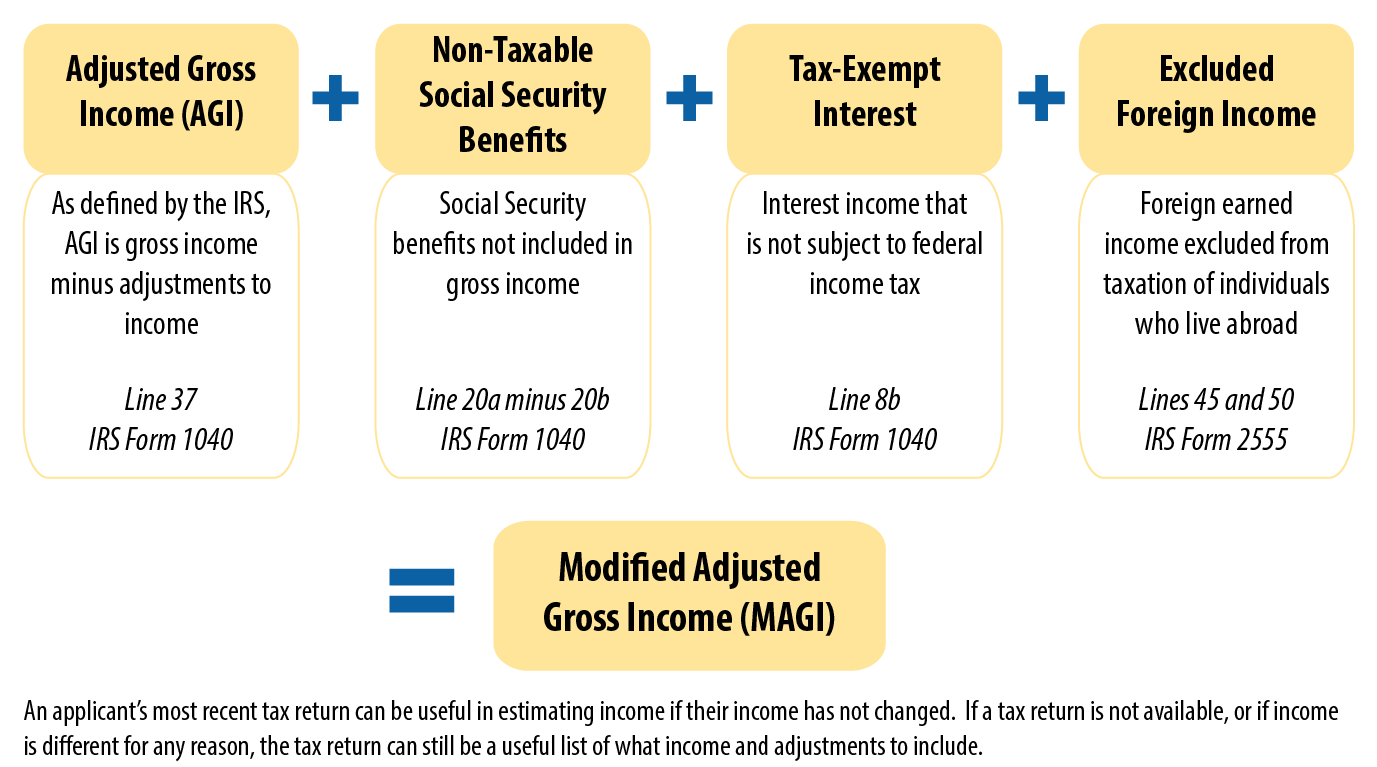
What Is Your Modified Adjusted Gross Income. In the most basic terms, modified adjusted gross income is defined as your adjusted gross income (agi) with certain adjustments added back in. Adjusted gross income (agi) is defined as your gross income minus certain adjustments.
A monetary value that can provide savings and consumption opportunities to an individual. It's not easy to define conceptually. Therefore, the definition of income could vary according to the research field. This article we will review the main elements of income. We will also examine rents and interest payments.
Gross income
Gross income is the sum of your earnings before taxes. On the other hand, net income is the sum of your earnings minus taxes. It is essential to comprehend the distinction between gross and net income , so that you can properly report your income. It is a better measure of your earnings due to the fact that it gives you a better view of the amount of money you earn.
Gross income is the total amount which a company makes before expenses. It allows business owners to evaluate the performance of their business over various periods and to determine the seasonality. Managers can also keep in the loop of sales quotas and productivity requirements. Knowing how much money a company earns before expenses is crucial in managing and growing a profitable enterprise. It allows small-scale businesses to evaluate how well they're performing in comparison to other businesses.
Gross income can be determined by product or company basis. For instance, a business is able to calculate profit by item through tracker charts. When a product sells well for the company, it will generate the highest gross earnings than a company with no products or services at all. It can assist business owners decide which products to concentrate on.
Gross income can include dividends, interest and rental earnings, as well as gambling profits, inheritances, and other income sources. But, it doesn't include payroll deductions. When you calculate your income, make sure that you take out any tax you are required to pay. Also, gross income should not exceed your adjusted net income. It is what you take home after accounting for all deductions you've made.
If you're employed, you most likely know what your net income will be. In many cases, your gross income is what you are paid before taxes are deducted. The information is available on your paycheck or contract. You don't own this documentation, it is possible to get copies of it.
Gross income and net income are key elements of your financial plan. Knowing and understanding them will help you create a spending plan as well as plan your financial future.
Comprehensive income
Comprehensive income is the total change in equity during a specified period of time. This measure does not take into account changes in equity resulting from owner-made investments as well as distributions made to owners. This is the most widely used measure to measure how businesses perform. This is an important part of an entity's profitability. This is why it's crucial for owners of businesses to understand the implications of.
Comprehensive income was defined in the FASB Concepts Statement No. 6, and includes changes in equity derived from sources outside of the owners of the business. FASB generally adheres to this idea of all-inclusive income however, there have been some exceptions that require reporting the changes in liabilities and assets in the operation's results. These exceptions can be found in the exhibit 1, page 47.
Comprehensive income is comprised of income, finance charges, tax expenditures, discontinued operations or profit share. It also comprises other comprehensive income, which is the difference between net income recorded on the income account and comprehensive income. Additional comprehensive income includes gains not realized on securities that are available for sale and derivatives in cash flow hedges. Other comprehensive income also includes an actuarial gain from defined benefit plans.
Comprehensive income is a method for companies to provide the public with more information regarding their profitability. Contrary to net income this measure can also include unrealized earnings from holding and gains from translation of foreign currencies. Although these aren't included in net income, they're significant enough to be included in the report. In addition, they provide more of a complete picture of the company's equity.
Comprehensive income includes gains and losses that are not realized and losses on investments. The reason for this is that the value of equity of an organization can fluctuate during the period of reporting. This amount, however, isn't included in the computation of the net profit, because it's not directly earned. The amount is shown into the cash section of the account.
In the future as time goes on, the FASB keeps working to refine its accounting standards and guidelines which will make comprehensive income a more complete and important measure. The aim is to provide additional information into the organization's activities and enhance the ability to anticipate the future cash flows.
Interest payments
Earnings interest are taxed at ordinary income tax rates. The interest income is added to the total profit of the company. However, individual investors also need to pay taxes on this income based on the tax rate they fall within. For instance, in the event that a small cloud-based application company loans $5000 in December 15th the company must be liable for interest of $1,000 on the 15th of January in the next year. This is a huge number even for a small enterprise.
Rents
As a property proprietor you might have been told about rents as a source of income. What exactly are they? A contract rent is a type of rent that is negotiated between two parties. It may also be a reference to the extra revenue earned by a property owner and is not required to complete any additional tasks. A monopoly producer might charge a higher rent than a competitor although he or she doesn't have to perform any additional work. Additionally, a rent differential is an extra profit that results from the fertility of the land. It typically occurs during extensive land cultivation.
A monopoly also can earn quasi-rents , if supply does not catch up with demand. In this instance, there is a possibility to extend the meaning for rents to include all forms of monopoly profit. But this is not a reasonable limit to the definition of rent. It is imperative to recognize that rents can only be profitable when there is no overcapacity of capital in an economy.
There are also tax implications when renting residential homes. This is because the Internal Revenue Service (IRS) doesn't make it simple to rent residential homes. Therefore, the issue of whether or no renting is an income source that is passive is not an easy question to answer. The answer depends on numerous factors, but the most important part of the equation is how involved you are throughout the course of the transaction.
In calculating the tax implications of rental income, be sure be aware of the potential dangers of renting out your property. There is no guarantee that there will be renters always so you could end at a property that is empty and no income at all. There are other unexpected expenses, like replacing carpets or replacing drywall. There are no risks, renting your home can make a great passive income source. If you're able maintain the costs at a low level, renting can be a good way to start your retirement early. It can also serve as an insurance against the rising cost of living.
While there are tax issues when renting a property however, it is important to know it is taxed in a different way than income earned on other income sources. It is important to consult an accountant or tax professional before you decide to rent an apartment. Rental income can include pets, late fees and even work carried out by the tenant instead of rent.
These deductions include ira contributions, alimony payments, health savings. Adjusted gross income is your taxable income for the year,. Modified adjusted gross income (magi) the figure used to determine eligibility for premium tax credits and other savings for marketplace health insurance plans and for medicaid and the.
Adjusted Gross Income (Agi) Is Defined As Gross Income Minus Adjustments To Income.
Adjusted gross income (agi) is defined as your gross income minus certain adjustments. Your gross income includes only income subject to taxation, such as: Modified adjusted gross income (magi) can qualify you for a number of credits, benefits, and exclusions, which makes it important to calculate for tax purposes.
The Modified Adjusted Gross Income, Or Magi, Is Quite Significant When It Comes To Managing Your Accounts That Are Utilized To Meet All Requirements For Significant Tax Benefits.
Adjusted gross income is your taxable income for the year,. Modified adjusted gross income (magi) the figure used to determine eligibility for premium tax credits and other savings for marketplace health insurance plans and for medicaid and the. Your gross income (gi) is the simplest form of income.
In The Most Basic Terms, Modified Adjusted Gross Income Is Defined As Your Adjusted Gross Income (Agi) With Certain Adjustments Added Back In.
Your gross income is the total amount of money you earn in a year. What is your modified adjusted gross income? Your magi is determined by subtracting from (or not including in) your adjusted gross income (agi) the taxable amount of.
Calculate Your Adjusted Gross Income.
Modified adjusted gross income (magi) is used to determine whether a private individual qualifies for certain tax deductions. Your adjusted gross income is an individual’s total gross income minus specific deductions. Adjusted gross income, or agi, on the other hand, is calculated by subtracting certain adjustments from your gross income, like student loan interest or ira contributions.
What Is Modified Adjusted Gross Income For Medicare?
Tax definition of modified adjusted gross income. It modifies your agi by adding. You add all of your income together to get your total income for the year.
Post a Comment for "What Is Your Modified Adjusted Gross Income"