What Is The Purpose Of Income Statement
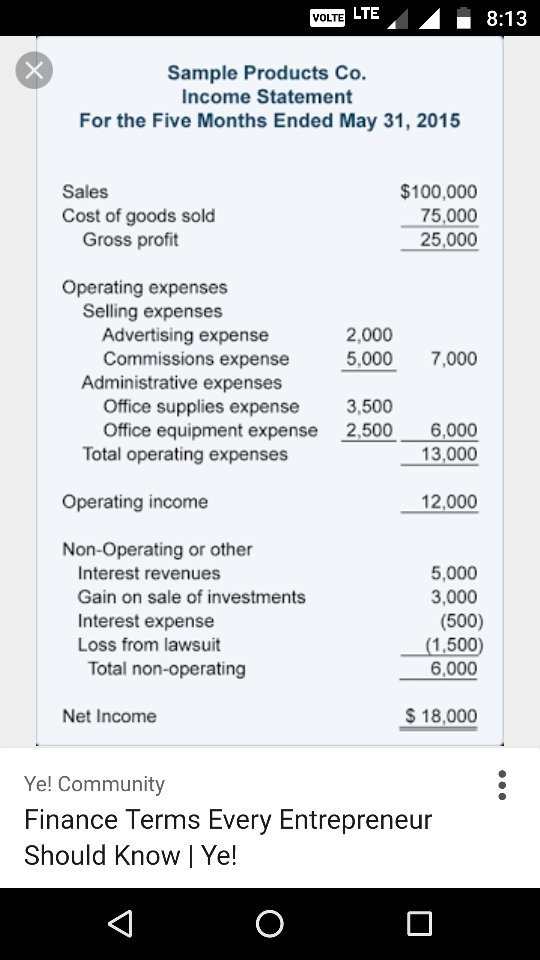
What Is The Purpose Of Income Statement. Heading, revenues and expenses, other ordinary items,. When preparing the income statement, several items require consideration:
The term "income" refers to a financial value that can provide savings and consumption opportunities to an individual. The issue is that income is hard to conceptualize. So, the definition of income can differ based on the area of study. Here, we'll examine some of the most important components of income. We will also examine rents and interest payments.
Gross income
A gross profit is sum of your earnings before tax. The net amount is the sum of your earnings, minus taxes. You must be aware of the distinction between gross and net income so that you know how to report your earnings. Net income is the more reliable measure of your earnings because it gives you a better picture of how much money it is that you are making.
Gross income is the revenue the business earns before expenses. It allows business owners to compare results across various times of the year and determine seasonality. It also assists managers in keeping an eye on sales quotas, as well as productivity needs. Knowing how much a business makes before expenses is vital to managing and growing a profitable enterprise. It helps small business owners understand how they are doing in comparison to their competition.
Gross income can be calculated either on a global or product-specific basis. In other words, a company may calculate profits by product through tracker charts. If the product is selling well, the company will have higher profits as compared to a company that does not sell products or services. This could help business owners select which products to be focused on.
Gross income comprises dividends, interest rent, gaming winners, inheritances, as well as other income sources. However, it does not include payroll deductions. When you calculate your income, make sure that you subtract any taxes that you are legally required to pay. Furthermore, your gross revenue should not exceed your adjusted gross income, which is what you actually take home after you have calculated all the deductions you've made.
If you're a salaried employee, you likely already know what your gross income is. In most instances, your gross income is the sum you are paid before tax deductions are made. This information can be found within your pay stubs or contracts. If you don't have this documents, you can order copies of it.
Net income and gross income are vital to your financial plan. Understanding and comprehending them will enable you to create a forecast and budget.
Comprehensive income
Comprehensive income refers to the total amount in equity over a set period of time. It does not include changes in equity as a result of private investments by owners and distributions made to owners. It is the most commonly employed method to evaluate the performance of business. This income is an crucial element of an organization's financial success. Thus, it's important for business owners to learn about this.
Comprehensive income can be defined by the FASB Concepts Declaration no. 6 and is comprised of changes in equity in sources other than owners of the company. FASB generally follows this idea of all-inclusive income however it occasionally has made exceptions , which require reporting changes in liabilities and assets in the operations' results. The exceptions are detailed in the exhibit 1, page 47.
Comprehensive income is comprised of the revenue, finance expenses, tax-related expenses, discontinued operations and profits share. It also comprises other comprehensive income, which is the gap between the net income that is reported on the income statement and comprehensive income. Additionally, other comprehensive income also includes gains that have not been realized in the form of derivatives and available-for-sale securities in cash flow hedges. Other comprehensive income also includes an actuarial gain from defined benefit plans.
Comprehensive income is a way for companies to provide their the public with more information regarding their efficiency. This is different from net income. It measure can also include unrealized earnings from holding and gains in foreign currency translation. Although they're not included in net income, they are important enough to be included in the statement. In addition, they provide more comprehensive information about the company's equity.
Comprehensive income includes gains and losses that are not realized and losses from investments. This is because of the fact that the worth of equity of an organization can fluctuate during the period of reporting. But this value cannot be included in the calculus of income net, since it isn't directly earned. The amount is shown by the credit section in the balance sheet.
In the near future the FASB has plans to refine its accounting guidelines and guidelines and will be able to make comprehensive income a much more complete and valuable measure. The objective is to give additional insights on the business's operations and increase the possibility of forecasting future cash flows.
Interest payments
Interest earned from income is taxes at ordinary taxes on income. The interest earned is added to the total profit of the company. But, the individual also has to pay taxes on this earnings based on their income tax bracket. For example, if a small cloud-based software business borrows $5000 on December 15 this year, it's required to make a payment of $1,000 of interest on January 15 of the following year. This is a huge number even for a small enterprise.
Rents
If you are a property owner, you may have heard about the concept of rents as an income source. What exactly are they? A contract rent is a term used to describe a rate that is agreed upon between two parties. It may also refer to the extra income that is obtained by a homeowner who is not obliged to carry out any additional duties. For instance, a producer who is monopoly may charge greater rent than his competitor although he or does not have to undertake any extra tasks. Additionally, a rent differential is an additional revenue that is made due to the soil's fertility. It usually occurs in areas of intensive cultivating of the land.
Monopolies can also earn quasi-rents , if supply does not catch up with demand. In this case, the possibility exists to expand the meaning that rents are a part of all forms of profits from monopolies. But this is not a sensible limit to the meaning of rent. It is essential to realize that rents can only be profitable if there isn't any overcapacity of capital in an economy.
Tax implications are also a factor for renting residential properties. For instance, the Internal Revenue Service (IRS) does not allow you to lease residential properties. So the question of whether or not renting is an income stream that is passive isn't an easy one to answer. The answer is contingent on a variety of aspects and the most significant is the level of your involvement with the rental process.
In calculating the tax implications of rental income, it is important to think about the risk of renting out your house. It's no guarantee that you will always have tenants, and you could end having a home that is empty with no cash at all. There are also unexpected costs including replacing carpets, or the patching of drywall. In spite of the risk involved rental of your home may be an excellent passive income source. If you are able to keep the costs at a low level, renting can be an ideal way to begin retirement earlier. It is also a good option to use as security against inflation.
Although there are tax considerations when renting a property however, it is important to know how rental revenue is assessed differently from income earned through other means. It is essential to speak with an accountant, tax attorney or tax attorney before you decide to rent the property. The rental income may comprise late fees, pet fee or even work that is performed by tenants in lieu of rent.
The statement displays the company’s revenue,. What is the purpose of the income statement. An income statement is a financial statement that reports a company's financial performance over a specific accounting period.
It Is Also Called A Profit And Loss Statement (P&L).
The purpose of the income statement is to show managers and investors whether the company made money (profit) or lost money (loss) during the period being reported. An income statement, otherwise known as a profit and loss (p&l) statement and profit and loss (p&l) account, is a record that measures and shows all the expenses and revenues a company. The income statement is one of three statements used in both corporate finance (including financial modeling) and accounting.
Managers Within The Firm, As Well As The Firm’s Owners And Lenders, Keep Track Of The Firm’s Performance By Reviewing Its Financial Statements.
Purpose of an income statement. An income statement lists a company’s income, expenses, and resulting profits over a specific time frame, usually a quarter or fiscal year. What is the purpose of the income statement.
Structure Of The Income Statement.
Companies create income statements for. You can use the income statement to. An income statement gives a detailed account of how much money you are making.
When Preparing The Income Statement, Several Items Require Consideration:
Purpose of the income statement. The statement displays the company’s revenue,. An income statement is a financial statement that reports a company's financial performance over a specific accounting period.
Heading, Revenues And Expenses, Other Ordinary Items,.
What are the top 7 uses of the income statement? The income statement is a highly crucial document that comments on a company’s profitability. An income statement includes gross profit and net.
Post a Comment for "What Is The Purpose Of Income Statement"