Per Capita Income Usa
Per Capita Income Usa. States, territories and the district of columbia by income. Gdp per capita for 2021 was $69,288, a 9.93% increase from 2020.
Income is a term used to describe a value which offers savings as well as consumption opportunities for an individual. However, income is not easy to define conceptually. So, the definition of the term "income" can vary according to the discipline of study. In this article, we'll analyze some crucial elements of income. In addition, we will examine interest payments and rents.
Gross income
Your gross earnings are the sum of your earnings before taxes. The net amount is the sum of your earnings, minus taxes. You must be aware of the distinction between gross and net revenue so that it is possible to report accurately your income. Net income is the more reliable indicator of your earnings because it provides a clearer idea of the amount that you can earn.
Gross profit is the money that a company makes prior to expenses. It helps business owners evaluate sales throughout different periods and to determine the seasonality. It also helps business managers keep on top of sales targets and productivity requirements. Knowing how much money an enterprise makes before its expenses is essential for managing and growing a profitable enterprise. It aids small-business owners see how they're competing with their peers.
Gross income can be determined by product or company basis. For instance, companies is able to calculate profit by item through tracker charts. If a product has a good sales an organization will enjoy higher profits over a company that doesn't have products or services. This helps business owners decide which products to concentrate on.
Gross income comprises dividends, interest rent income, gambling winnings, inheritances and other income sources. However, it does not include payroll deductions. When you calculate your income ensure that you remove any taxes you're obliged to pay. Furthermore, your gross revenue should never exceed your adjusted gross total income. This is the amount you get after figuring out all the deductions you've taken.
If you're employed, you probably already know what your average gross salary is. In many cases, your gross income is what that you get paid prior to tax deductions are made. This information can be found in your pay-stub or contract. When you aren't able to find the documentation, you can get copies.
Net income and gross income are key elements of your financial plan. Understanding and understanding them can assist you in establishing a spending plan as well as plan your financial future.
Comprehensive income
Comprehensive income is the sum of the changes in equity over the course of time. This measure does not take into account changes in equity as a result of investing by owners and distributions made to owners. This is the most widely utilized method to gauge the performance of business. The amount of money earned is an significant element of a business's financial success. It is therefore crucial for business owners to understand the implications of.
Comprehensive income will be described by FASB Concepts Statement no. 6, and it includes any changes in equity coming from sources other than the owners the company. FASB generally adheres to the concept of an all-inclusive income but has occasionally made specific exceptions , which require reporting the change in assets and liabilities in the operations' results. The exceptions are detailed in the exhibit 1 page 47.
Comprehensive income is comprised of revenues, finance costs, tax expenses, discontinued operations also profit sharing. It also comprises other comprehensive income, which is the distinction between net income as recorded on the income account and comprehensive income. Other comprehensive income comprises gains that are not realized on available-for-sale securities and derivatives being used as cashflow hedges. Other comprehensive income includes gain from actuarial calculations from defined benefit plans.
Comprehensive income can be a means for companies to provide stakeholders with additional data about their business's performance. This is different from net income. It measure contains unrealized hold gains as well as foreign currency exchange gains. Although these aren't included in net income, they are important enough to be included in the report. Furthermore, it offers more comprehensive information about the company's equity.
Comprehensive income includes gains and losses that are not realized and losses on investments. This is because of the fact that the worth of the equity of a business can fluctuate during the period of reporting. However, this amount isn't included in the formula for calculating net income because it's not directly earned. The different in value can be seen by the credit section in the balance sheet.
In the near future the FASB continues to improve its guidelines and accounting standards making comprehensive income an more comprehensive and vital measure. The aim is to offer additional insight about the operation of the firm and increase the possibility of forecasting the future cash flows.
Interest payments
Income interest payments are taxed at ordinary rate of taxation on earnings. The interest income is added to the overall profit of the company. However, individuals are also required to pay taxes in this amount based upon your tax bracket. As an example, if small cloud-based software company borrowed $5000 in December 15th however, it has to pay $1,000 in interest at the beginning of January 15 in the next year. This is a substantial amount for a small-sized company.
Rents
As a landlord I am sure you've heard about the concept of rents as a source of income. What exactly are rents? A contract rent is an amount that is negotiated between two parties. It may also be a reference to the additional revenue attained by property owners and is not required to complete any additional tasks. For instance, a producer who is monopoly may charge greater rent than his competitor in spite of the fact that he doesn't have to carry out any additional tasks. Also, a difference rent is an additional revenue which is generated by the fertility of the land. It is usually seen in the context of extensive cultivation of land.
Monopolies also pay quasi-rents , if supply does not catch up to demand. In this situation one could extend the definition of rents in all kinds of profits from monopolies. This is however not a reasonable limit to the definition of rent. It is crucial to remember that rents are only profitable if there isn't any supply of capital in the economy.
There are tax implications for renting residential properties. There are tax implications when renting residential properties. Internal Revenue Service (IRS) doesn't make it simple to rent residential homes. So the question of whether renting is a passive income is not an easy one to answer. The answer depends on numerous aspects but the most crucial aspect is your involvement during the entire process.
When calculating the tax consequences of rental income, it is important to think about the possible dangers in renting your property. It's no guarantee that there will be renters always however, and you could wind with a house that is vacant and no income at all. There are also unforeseen expenses such as replacing carpets or patching holes in drywall. Regardless of the risks involved in renting your home, it can be a fantastic passive income source. If you're able maintain the costs down, renting can be an ideal way to get retired early. This can also act as a way to protect yourself against inflation.
Although there are tax implications for renting property however, it is important to know it is taxed in a different way than income from other sources. It is imperative to talk with an accountant or tax expert in the event that you intend to lease the property. Rent earned can be comprised of late fees, pet charges and even work completed by the tenant for rent.
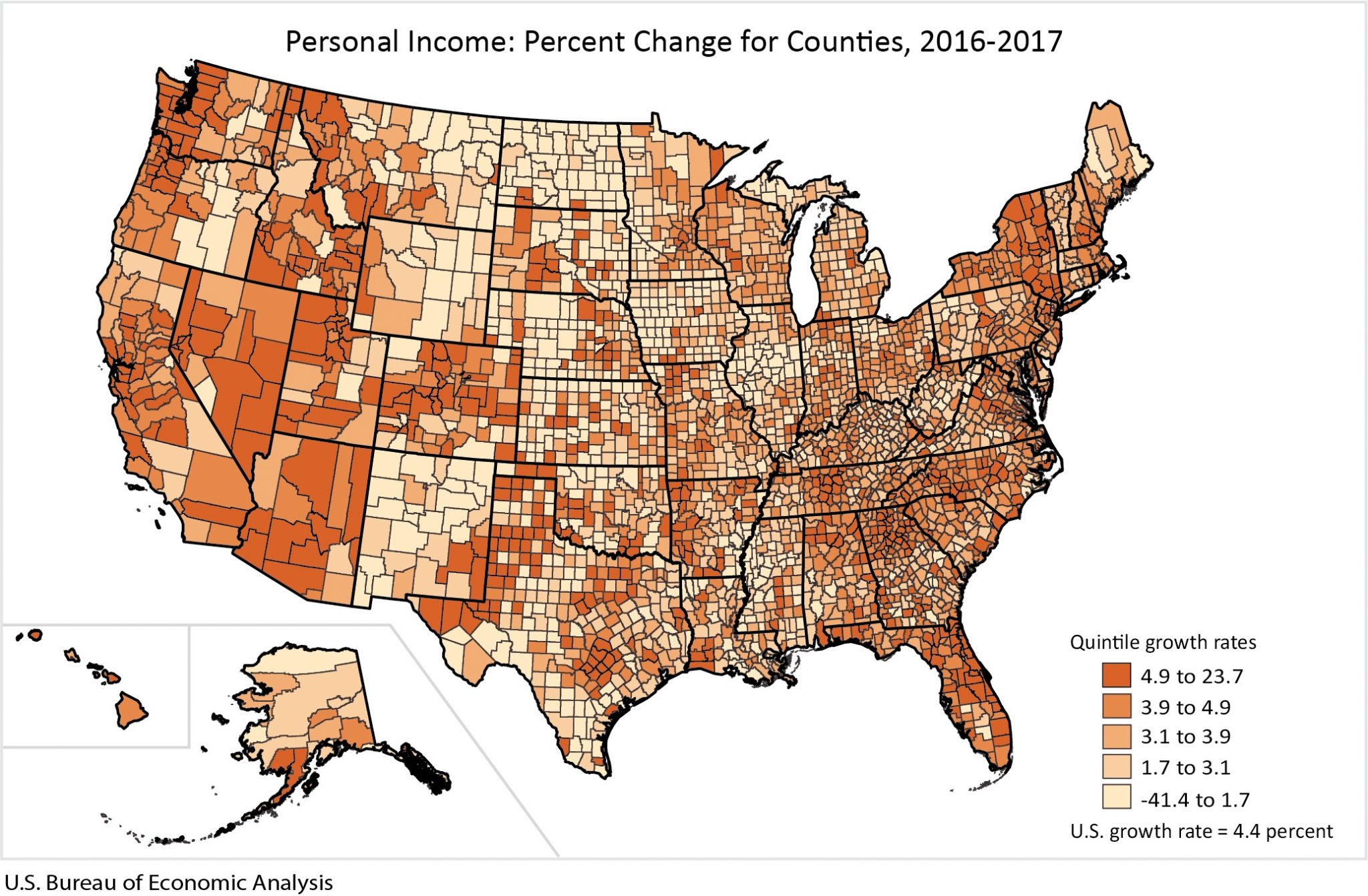
There are 22 states that have real per capita incomes that exceed the u.s. Real per capita personal income for united states. Income per capita is a measure of the amount of money earned per person in a certain area.
States, Territories And The District Of Columbia By Income.
Bea used census population figures to calculate annual per. The united states census has race and ethnicity as defined by the office of management and budget in 1997. Per capita income average of $53,504.
Map Of States By Median Household Income In 2019.
66 rows when measured in current dollars, the united states' per capita personal income increased 2,738.2%, from $2,260 in 1959 to $64,143 in 2021. Geographically, these states are quite diverse, running from. There are 22 states that have real per capita incomes that exceed the u.s.
Income Per Capita Is A Measure Of The Amount Of Money Earned Per Person In A Certain Area.
This statistic shows the per capita personal income in the united states from 1990 to 2021. $19.33 was the median wage per hour in the us in. In 2021, the per capita.
Published By Statista Research Department , Sep 30, 2022.
This is a list of u.s. The average annual real wage in 2019 in the us was $65,836. [1] the following median per capita income data are retrieved from american.
Gdp Per Capita For 2021 Was $69,288, A 9.93% Increase From 2020.
Dollars using the world bank atlas method, divided by the midyear. According to the 2018 gdp per capita statistics, the united states emerged as the most. The median household income in the us in 2019 was $68,703.
Post a Comment for "Per Capita Income Usa"