Adjusted Gross Income Vs Modified Adjusted Gross Income
Adjusted Gross Income Vs Modified Adjusted Gross Income. Adjusted gross income is your taxable income for the year,. So each party pays 7.65% of their.
The concept of income is one which provides savings and consumption opportunities to an individual. It's a challenge to define conceptually. Thus, the definition of the term "income" can vary according to the specific field of study. Here, we will examine some of the most important components of income. We will also take a look at rents and interest payments.
Gross income
Your gross earnings are the total sum of your earnings before taxes. By contrast, net income is the sum of your earnings, minus taxes. You must be aware of the distinction between gross and net income , so that you are able to properly record your income. It is a better gauge of your earnings because it gives a clear understanding of how much it is that you are making.
The gross income is the amount that a company makes prior to expenses. It allows business owners to compare results across various times of the year as well as determine seasonality. Managers also can keep track of sales quotas and productivity requirements. Knowing the amount a company earns before expenses is essential for managing and growing a profitable firm. This helps small business owners evaluate how well they're competing with their peers.
Gross income can be calculated according to a product-specific or a company-wide basis. For instance a business can determine profit per product using charting. If the product is selling well for the company, it will generate more revenue when compared to a business with no products or services. This could help business owners determine which products they should concentrate on.
Gross income comprises dividends, interest rentals, dividends, gambling profits, inheritances, and other sources of income. However, it does not include payroll deductions. When you calculate your income ensure that you subtract any taxes you are legally required to pay. Additionally, your gross income must never exceed your adjusted gross revenue, which represents what you will actually earn after accounting for all deductions you've made.
If you're a salaried worker, you likely already know what your average gross salary is. In most instances, your gross income is what you receive before taxes are deducted. The information is available on your pay statement or contract. If you're not carrying this documentation, you may request copies of it.
Gross income and net earnings are critical to your financial situation. Understanding them and how they work will help you develop a schedule for your budget as well as planning for the next.
Comprehensive income
Comprehensive income is the sum of the changes in equity over a long period of time. This measure does not take into account changes in equity resulting from ownership investments and distributions made to owners. It is the most commonly used measurement to assess the performance of companies. This kind of income is an significant aspect of an enterprise's financial success. Therefore, it is important for business owners to get the significance of this.
The term "comprehensive income" is found in the FASB Concepts Statement no. 6, and it includes changes in equity from sources other than the owners of the business. FASB generally adheres to the concept of all-inclusive income, but has occasionally made specific exceptions that require reporting of the change in assets and liabilities in the operation's results. The specific exceptions are listed in exhibit 1, page 47.
Comprehensive income is comprised of funds, revenues, taxes, discontinued operations, or profit share. It also includes other comprehensive income, which is the gap between the net income which is reported on the income statements and comprehensive income. In addition, other comprehensive income includes gains not realized on securities that are available for sale and derivatives in cash flow hedges. Other comprehensive income includes an actuarial gain from defined benefit plans.
Comprehensive income provides a means for companies to provide users with additional details about their profitability. Like net income however, this measure additionally includes unrealized gain on holding and foreign currency exchange gains. Although these aren't part of net income, they're crucial enough to include in the financial statement. Furthermore, it provides the most complete picture of the company's equity.
Comprehensive income includes gains and losses that are not realized and losses from investments. This is because of the fact that the worth of equity in the business could change over the period of reporting. The equity amount is not part of the calculations of net earnings, because it's not directly earned. The variance in value is then reflected at the bottom of the balance statement, in the equity category.
In the coming years the FASB can continue to improve its accounting rules and guidelines which will make comprehensive income a greater and more accurate measure. The objective is to provide further insights into the operation of the company and increase the possibility of forecasting the future cash flows.
Interest payments
In the case of income-related interest, it is taxed at normal taxes on income. The interest income is included in the overall profits of the business. However, individuals also have to pay taxes on this earnings based on their income tax bracket. For instance, in the event that a tiny cloud-based software firm borrows $5000 in December 15th the company must pay interest of $1,000 on the 15th day of January of the next year. This is a huge number to a small business.
Rents
As a home owner Perhaps you've heard about the concept of rents as an income source. But what exactly are rents? A contract rent is a term used to describe a rate which is decided upon between two parties. It could also refer the extra income that is generated by a property owner which is not obligated undertake any additional work. For instance, a monopoly producer might charge higher rent than a competitor and yet isn't required to do any extra tasks. Similarly, a differential rent is an additional revenue resulted from the fertileness of the land. It generally occurs under extensive agriculture of the land.
A monopoly may also earn quasi-rents up until supply catch up to demand. In this instance, there is a possibility to extend the meaning of rents and all forms of monopoly earnings. However, this isn't a logical limit for the definition of rent. Important to remember that rents are only profitable when there's no excess of capital available in the economy.
Tax implications are also a factor in renting residential property. This is because the Internal Revenue Service (IRS) does not allow you to rent residential properties. The question of whether or not renting is a passive income is not an easy question to answer. The answer is contingent upon a number of factors, but the most important is the level of your involvement with the rental process.
In calculating the tax implications of rent income, it is necessary to consider the potential risks from renting out your home. It's not certain that you will always have renters which means you could wind in a vacant home without any money. There are also unforeseen expenses including replacing carpets, or patching drywall. No matter the risk it is possible to rent your house out to become a wonderful passive source of income. If you're able to keep costs low, it can be an excellent way to save money and retire early. It also can be security against inflation.
While there are tax issues of renting out a property however, it is important to know renting income will be treated differently than income earned through other means. It is essential to speak with an accountant or tax lawyer when you are planning to rent properties. Rental income can comprise pets, late fees and even services performed by the tenant to pay rent.
So each party pays 7.65% of their. These funds, usually provided through life insurance policies, are. The irs uses magi to determine.
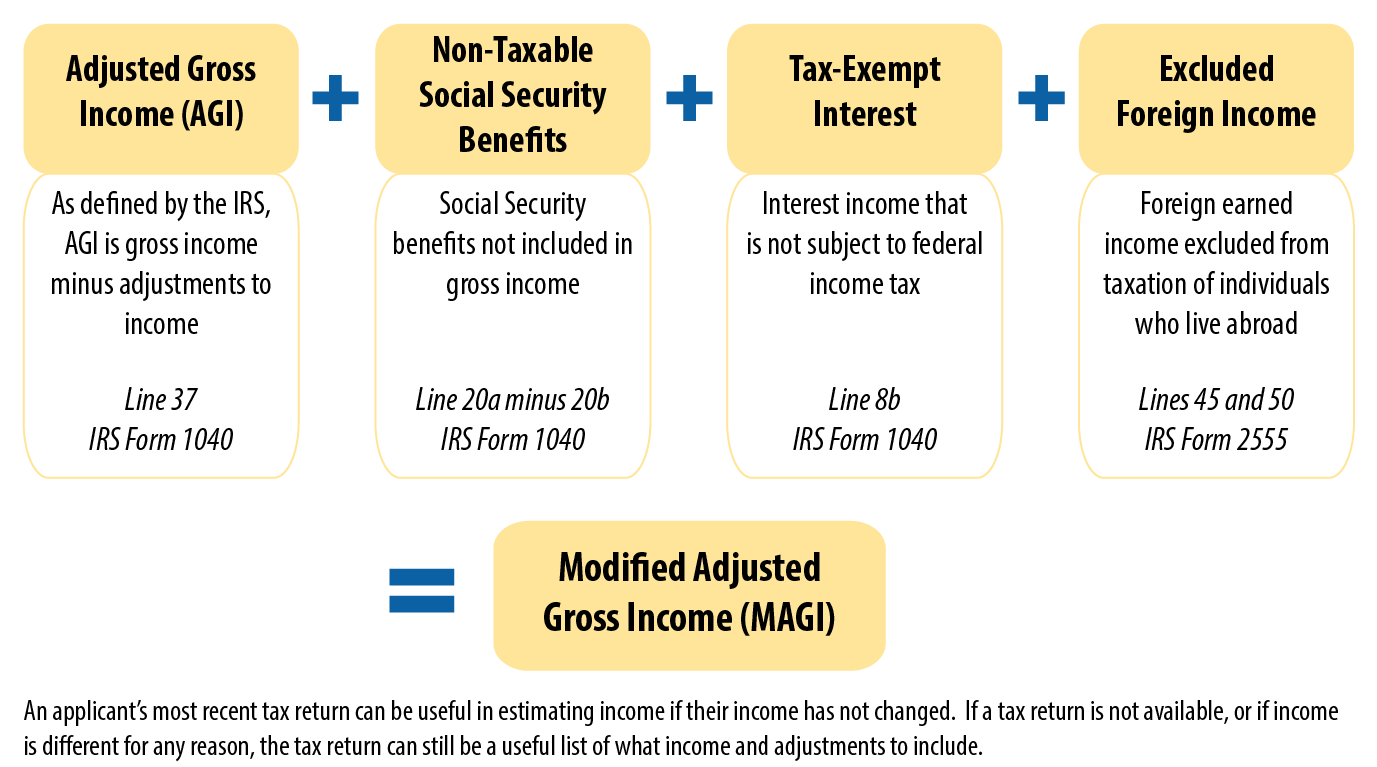
Modified Adjusted Gross Income (Magi) In The Simplest Terms Is Your Adjusted Gross Income (Agi) Plus A Few Items — Like Exempt Or Excluded Income And Certain Deductions.
Your gross income (gi) is the simplest form of income. Gross income is the total amount of money you make in a year before taxes. Your gross income includes only income subject to taxation, such as:
The Irs Uses Magi To Determine.
Adjusted gross income (agi) is defined as your gross income minus certain adjustments. Income paid to the dependent(s) of a primary wage earner in the event of his or her death. So each party pays 7.65% of their.
Modified Adjusted Gross Income (Magi) The Figure Used To Determine Eligibility For Premium Tax Credits And Other Savings For Marketplace Health Insurance Plans And For Medicaid And The.
Tax definition of modified adjusted gross income. It includes all the money you earned without any tax deductions figured in. Once you know your total income for the fiscal year, you.
We Know That Agi Appears.
Modified adjusted gross income, or magi, is adjusted gross income that is modified further by adding back items. Your gross income is the total amount of money you earn in a year. The modified adjusted gross income (magi) is calculated by taking the adjusted gross income and adding back certain allowable deductions.
Your Agi Is The Total Amount Of Income You Make In A Year, Minus Certain Expenses That You Are Allowed To Deduct.
You add all of your income together to get your total income for the year. Many of these deductions can be rare, so it's possible your agi and magi. These funds, usually provided through life insurance policies, are.
Post a Comment for "Adjusted Gross Income Vs Modified Adjusted Gross Income"